
The Webster Technique: How Chiropractic Supports a Smoother Pregnancy and Birth
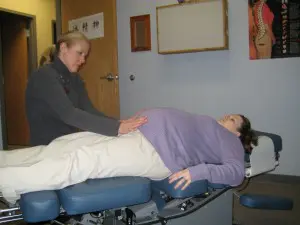
The Webster Technique in Mt. Horeb, WI
Hello! Dr. Brenda here from New Beginnings Chiropractic. In our office, we see pregnancy, birth, and postpartum as natural, powerful processes—not medical conditions that always need to be controlled. Chiropractic care, and specifically the Webster Technique, is one way we support your body’s ability to do what it was designed to do.
In this post, I’ll explain what the Webster Technique is, how it may support an easier pregnancy and birth, and what it is not (hint: it’s not a baby-flipping maneuver).
Pregnancy: A Beautiful, Intense Time of Change
During pregnancy, your body goes through major neurological, biomechanical, chemical, and physiological changes. Your posture shifts, your pelvis moves, your ligaments soften, your hormones change, and your nervous system is constantly adapting to support you and your growing baby.
Most chiropractors view pregnancy and birth as natural processes. Our job is to help your body adapt to the changes by improving alignment and nervous system function, so everything can work the way it was designed to.
How Chiropractic Helps Mom During Pregnancy
Chiropractic care in pregnancy focuses on:
- Balancing the sacrum and pelvis
Gentle, specific adjustments help create balance in the pelvic bones, muscles, and ligaments. When the pelvis is aligned, the uterus can sit more evenly, with less torsion or twisting. - Reducing ligament torsion
The ligaments that support the uterus attach to the pelvis and sacrum. If the pelvis is misaligned, those ligaments can be pulled unevenly, which may create tension and torsion on the uterus itself. - Supporting the nervous system
Your nervous system controls and coordinates every system in your body—including your uterus and the muscles involved in labor. By reducing interference in the spine, sacrum and pelvis, chiropractic helps the brain and body communicate more clearly.
When we improve alignment and nerve communication for the mother, we’re supporting normal physiology—and that often means fewer interventions and a smoother experience overall.
How This Helps Baby Too
When the pelvis is balanced and the uterus is not under abnormal tension, baby benefits as well:
- Baby has more room to move and grow, helping reduce the chance of restriction to the developing cranium, spine, and other skeletal structures.
- There is more space and freedom for baby to move into the best possible position for birth, usually head-down and slightly on the left side.
- With proper fetal positioning, studies and clinical experience suggest there may be a decrease in dystocia (difficult or stalled labor) and birth interventions.
Again, we’re not “treating the baby.” We’re working with mom’s body. When her body functions better, it naturally supports baby.
What Is Dystocia?
Dystocia is the medical term for abnormal or difficult labor. It can include:
- Labor that doesn’t progress (“failure to progress”)
- Baby not descending properly
- Baby being in a less-than-ideal position
- Maternal exhaustion and prolonged labor
Common causes of dystocia include:
- Power – Uterine contractions that are not strong enough or not well-coordinated, or difficulty with pushing.
- Passage – The bony pelvis or soft tissues are not allowing enough space for baby to rotate and descend.
- Passenger – Baby’s position (breech, transverse, posterior) or size makes the process more challenging.
Chiropractic care, including the Webster Technique, focuses especially on the biomechanical and neurological side of things—the “power” and the “passage.”
How the Nervous System and Pelvis Affect Labor
- Your uterus is a muscle. Like every other muscle, it is controlled by nerves.
- If the nerves innervating the uterus are not functioning optimally due to spinal or sacral misalignment (called subluxation in chiropractic), contractions may be weaker, less coordinated, or less efficient.
- Your pelvis and sacrum form the opening baby must pass through. If the sacrum or pelvic bones are misaligned, the available space can be reduced—even by a few millimeters, which matters a lot when a whole baby is coming through!
Chiropractic adjustments aim to:
- Improve nerve-to-muscle communication for stronger, more coordinated uterine contractions.
- Align the pelvic and sacral structures so there’s as much space as possible for baby to rotate and descend.
- Support the balance between the sympathetic (fight-or-flight) and parasympathetic (rest-and-digest) nervous systems, making it easier for your body to relax into labor instead of feeling stuck in stress mode.
Think of a laboring cat or dog—if they are startled or feel unsafe, labor often stops. Humans are no different. A body stuck in fight-or-flight has a harder time giving birth. Chiropractic can support you in getting and staying in a calmer, more parasympathetic state.
So… What Exactly Is the Webster Technique?
The Webster Technique is a specific chiropractic analysis and adjustment protocol that focuses on:
- Sacral subluxation (misalignment of the sacrum/tailbone)
- Sacroiliac (SI) and pubic symphysis joint function
- Tension and balance in key muscles and ligaments of the pelvis and abdomen
During a Webster assessment, we typically evaluate:
- The sacrum (tailbone)
- Piriformis muscle in the buttocks
- Sacrotuberous ligament
- Pubic bone in the front of the pelvis
- Psoas muscles (hip flexors)
- Round ligaments of the uterus at the front of the abdomen
The goal is to correct sacral and pelvic misalignments, reduce ligament and muscular tension, and allow the uterus to be as balanced as possible.
This may:
- Improve nerve communication to the uterus
- Increase pelvic space
- Reduce uterine torsion
- Give baby the best chance to move into an optimal position on their own
Important: What the Webster Technique Is Not
There is a lot of confusion around this, so we need to be very clear:
- The Webster Technique is NOT:
- A “baby-turning” technique
- An obstetric procedure
- Forceful manipulation of the abdomen
- The same as an external cephalic version (ECV) performed by an OB
- Chiropractors using Webster:
- Do not palpate to determine fetal position (that’s your OB or midwife’s job)
- Do not force a baby to flip or go head-down
- Do not practice obstetrics—we adjust the spine and pelvis and work with the nervous system
What we do is correct misalignments and imbalances in the pelvis, sacrum, and associated soft tissues, and then the mom’s body (and baby) decide what to do with that improved function and communication.
Sometimes that means baby turns head-down. Sometimes baby doesn’t turn—and that can be for many reasons, including short cord, uterine anomalies, position of placenta, multiples, or baby knowing that another position is safer. In those cases, the chiropractic care did not fail. Your body and your baby are still healthier and more resilient having had chiropractic care before birth or cesarean.
When Should You Start Webster-Based Chiropractic Care?
The earlier, the better.
- Ideal time:
- Before conception or as soon as you find out you’re pregnant
- Why:
- We can correct and maintain alignment before patterns get “locked in”
- We can coach you on daily habits, posture, and positions that keep your pelvis balanced
- Regular care reduces the likelihood of late-pregnancy malposition and dystocia
Many women first hear about Webster when baby is already breech or posterior at 34–36 weeks. It is still worth coming in, but it’s like trying to play catch-up in the fourth quarter. There’s less room and less time for baby to move, and the emotional stress can add more tension to the system.
Even then, chiropractic care can:
- Reduce discomfort
- Support your nervous system
- Help prepare your body to handle whatever birth outcome is needed—vaginal, assisted, or cesarean—with more ease and resilience.
Why Your Midwife or OB Might Refer You for Webster
If your birth provider has referred you to a chiropractor trained in the Webster Technique, that’s a good sign:
- They trust your body’s ability to birth.
- They want to help you avoid unnecessary interventions when possible.
- They recognize that sacral and pelvic alignment and uterine balance matter.
Our goal is to be part of your birth dream team—working alongside your midwife, OB, or doula to support the safest, healthiest outcome for you and your baby.
Final Thoughts on Prenatal Chiropractic and the Webster Technique in Mt Horeb
The Webster Technique is not a magic wand and it’s not a guarantee that your baby will flip. But it is a powerful way to:
- Support normal function in your spine, pelvis, and nervous system
- Reduce tension and torsion on the uterus and surrounding ligaments
- Create the best possible conditions for your baby’s position and your birth experience
Whether your birth ends up being at home, in a birth center, or in the hospital—vaginal or cesarean—chiropractic care can help your body and baby handle the process with greater ease.
If you have questions about the Webster Technique, breech positioning, or prenatal chiropractic care, you’re always welcome to call our office. We’d be honored to support you during this incredible journey.